
Are PayID Casinos Legal in Australia? Reading the Law Straight
 Available in US
The legal status of PayID casinos, stated plainly
I am not a lawyer, and nothing here is legal advice, but after nine years explaining this niche I can tell you the question “are PayID casinos legal in Australia” is almost always asked with the wrong assumption baked in. People assume online casinos work like the betting apps they see advertised during the footy. They do not, and that single misconception is responsible for most of the confusion.
Table of Contents
So here is the plain version. Online casinos, the kind that offer pokies and table games to Australians, are not licensed in Australia. Under the Interactive Gambling Act 2001, providing online casino-style gambling to people in Australia is prohibited, which is why the operators serving Aussie players are, almost without exception, based offshore. This is the crucial fact that separates an online casino from a sports betting site, and it is the fact nearly every competing article either skips or fudges.
The PayID part of the question is, by comparison, simple. PayID is a legal, mainstream Australian payment method used by tens of millions of people for entirely ordinary purposes. Using PayID does not make anything illegal, and it does not make an offshore casino legal either. The payment method and the legality of the activity are two separate questions, and conflating them, as a lot of listings quietly do, produces a comforting but false impression that “PayID casino” is some kind of sanctioned, regulated category. It is not. It is an offshore casino that happens to accept a legal payment rail.
What I want to do in this piece is walk through what the law actually prohibits and what it leaves alone, why sports betting is treated so differently from online casinos, how the regulator enforces the rules in practice, what the payment bans changed, and, most importantly for you, where the player personally stands. The tone here is deliberately careful, because this is law, not opinion, and getting it precisely right matters more than making it sound reassuring.
What the Interactive Gambling Act actually bans
The first thing to understand about the Interactive Gambling Act is who it points at, because that single design choice explains almost everything that follows. The Act regulates the supply of gambling services, which means its prohibitions are aimed squarely at operators, not at the individuals who use them. That orientation shapes the entire enforcement landscape, and it is the key to understanding the player’s position later.
What the Act prohibits is the provision of certain interactive gambling services to people physically in Australia. Online casino games, the pokies and table games at the heart of “PayID casinos,” fall inside that prohibition. It is unlawful for an operator to provide these services to Australians, which is precisely why no Australian company offers them and why the operators that do are offshore, beyond the easy reach of the domestic enforcement the Act creates.

The Act does not prohibit everything that looks like gambling, though, and the exceptions are what create the confusion. Licensed wagering on sports and racing is permitted under specific conditions, lotteries are permitted, and these carve-outs are why you see legal, advertised, Australian-licensed betting brands alongside a prohibition on online casinos. The line the Act draws is not “gambling versus no gambling.” It is “this specific list of permitted, licensable activities versus everything else, which is prohibited to supply.” Online casino gaming sits firmly on the prohibited side of that line.
The regulatory direction of travel reinforces how seriously this framework is now taken. The financial intelligence regulator’s chief executive has described the current period as a shift “from regulation that primarily checks for compliance to one focussed on substantive risks and harms,” which signals that the appetite for letting prohibited supply slide is shrinking, not growing. The framework is not a dead letter. It is being actively sharpened, and the operators feel it even where the players do not.
Online casino vs licensed wagering: the key split
Let me make the most consequential distinction in this whole topic as sharp as I can, because if you take one thing away, this is it. The reason a sports betting site can run television ads while an online casino cannot operate in Australia at all comes down to which side of the Act’s permitted list each one falls on.
Licensed wagering, betting on sports and racing, is a permitted activity that Australian states and territories can license, which is why those operators are local, regulated, taxed, and visible. They answer to Australian regulators, they hold Australian licences, and a player using them is using a sanctioned, supervised service. When something goes wrong, there is a domestic body with jurisdiction over the operator. That is the world most people picture when they think about online gambling, because it is the world they see advertised.
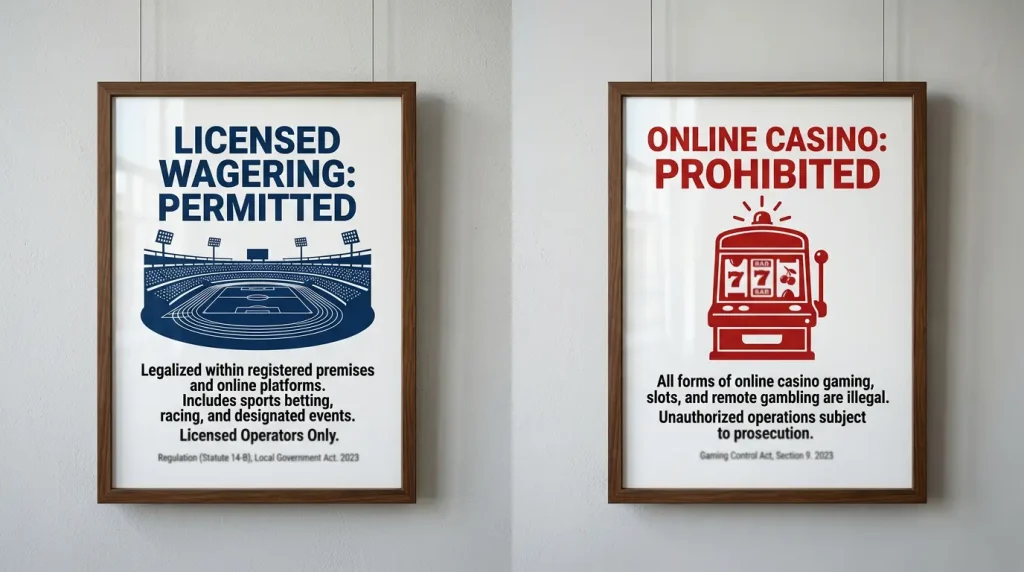
Online casino gaming is not on that permitted list, so it cannot be licensed in Australia, full stop. An operator offering pokies and table games to Australians is providing a prohibited service, which forces it offshore by definition. The consequence for you is profound and frequently invisible: the supervised, recourse-backed world of licensed wagering simply does not extend to online casinos. Players often assume the protections they have heard about in the betting context carry over, and they do not, because the two activities live on opposite sides of the legal line. A “PayID casino” is in the unlicensed, offshore, prohibited-to-supply category, no matter how polished its website looks.
How ACMA enforces the rules
People often assume that because online casinos are prohibited, nothing is actually done about them, and that assumption is wrong in a way worth seeing in detail. The communications regulator runs an active enforcement programme against illegal operators, and the figures show it is busy.
In the second quarter of 2025 alone, the regulator assessed 292 of the 330 complaints it received about interactive gambling, opened 20 investigations, issued 10 formal warnings, and identified 73 sites that had breached the law. That is a single quarter of activity, and it describes a regulator working through a steady pipeline of complaints and turning a meaningful share of them into investigations and warnings. The prohibition is not theoretical; it generates real casework on a continuous basis.

Enforcement also reaches the licensed side with real teeth, which tells you what the regulator can do when it has jurisdiction. In one case the wagering operator Betchoice paid a one million dollar penalty and accepted a two-year commitment to have its systems independently reviewed. That is what consequences look like when an operator is within Australian reach. The instructive contrast is that offshore online casinos are largely beyond that reach, which is exactly why enforcement against them relies on different tools, blocking and pressure to exit, rather than fines an offshore entity could simply ignore.
It is worth pausing on why warnings work at all against entities the regulator cannot easily fine. The mechanism is reputational and operational pressure rather than direct punishment. A formal warning puts an operator on notice, feeds into the case for blocking, and signals to payment providers and software suppliers that the operator is in the regulator’s sights, which raises the cost of doing business with Australia. For an offshore casino weighing whether the Australian market is worth the friction, accumulating warnings and a place on the block list tips the calculation, which is precisely how a regulator with limited cross-border reach still shapes behaviour. The enforcement is indirect, but it is not toothless, and the steady quarter-on-quarter casework shows it grinding forward continuously.
The thread running through all of this is that enforcement is aimed at supply, at the operators, consistent with how the Act is built. The regulator investigates and warns operators; it does not pursue the individual players who used them. That distinction is not a loophole or a technicality. It is the deliberate structure of the law, and understanding it is essential to understanding your own position, which I will come to shortly.
Site blocking and operators leaving the market
The most visible tool the regulator uses against offshore operators is one you may have run into yourself without knowing what you were seeing: the blocked-site page that appears when you try to reach a casino that has been taken off the table. This is site blocking, and the scale of it is larger than most players realise.
From the first blocking request in November 2019 through to December 2025, 1,455 illegal gambling and affiliate sites had been blocked. That is a substantial, sustained programme, not a handful of symbolic actions, and it means the offshore casino landscape is far less stable than it appears from the inside. A site you deposit into today can be on a block list tomorrow, at which point reaching it, and your account, becomes abruptly difficult.

Blocking is not the only pressure. Around 220 illegal services have voluntarily left the Australian market since the rules were tightened in 2017, choosing exit over the friction of being pursued. For a player, the lesson in both numbers is the same: offshore operators are a moving target, and the instability is a direct product of enforcement working as intended. What happens to your funds when a casino you use is suddenly blocked or exits is a genuine practical risk, and I cover the mechanics of that situation in detail in my piece on what it means when ACMA blocks a casino site.
The credit card and crypto payment bans
A major shift that reshaped the payment landscape, and that bears directly on why PayID became so prominent, is the prohibition on certain payment types for licensed gambling. Understanding it clears up a lot of confusion about what is and is not allowed at the payment layer.
From 11 June 2024, licensed betting operators in Australia were prohibited from accepting credit cards, credit-related products, and cryptocurrency, and the regulator assessed compliance with this ban as “very high.” The reasoning is harm-focused: stopping people from gambling with borrowed money and with the volatile, hard-to-trace value that crypto represents. The ban applies to the licensed operators within Australian reach, which is the part of the industry the regulator can actually direct.

This is where a careful distinction matters, because it is easy to misread. The payment ban targets licensed operators, while online casinos are an entirely separate, prohibited category that sits outside the licensed framework. So the ban does not “legalise” anything about online casinos, nor does it specifically govern what an offshore casino chooses to accept. What it does do is signal, at a policy level, that Australian authorities regard credit and crypto as higher-risk funding methods for gambling, which is useful context when you are weighing how you would fund any gambling activity.
The practical effect on the PayID story is indirect but real. With credit cards pushed out of licensed gambling and crypto formally disfavoured, account-to-account methods like PayID, funded from money you actually have rather than money you have borrowed, became the natural mainstream rail. PayID’s prominence in this space is partly a consequence of the bans clearing the field of the alternatives the regulator wanted gone. The deeper rationale and the full scope of these prohibitions deserve their own treatment, which is why I unpack them separately, but the headline for legality purposes is that no payment method, PayID included, changes the legal status of an online casino. It only changes how the money moves.
Where the player legally stands
Now the question you actually came for, asked honestly: what is the player’s legal position when using an offshore PayID casino? I will answer it as precisely as I can while being clear that this is explanation, not legal advice, and that your own circumstances may differ.
The Interactive Gambling Act, by design, points at operators supplying prohibited services, not at the individuals who access them. The enforcement record bears this out: the regulator investigates operators, warns operators, blocks operator sites, and pursues operators with penalties where it has reach. The published activity is overwhelmingly supply-side. There is not a programme of pursuing individual players for accessing offshore online casinos, and the structure of the Act explains why, since the prohibition is framed around the provision of the service rather than its use.
But “the law mainly targets operators” is not the same as “the player has nothing to worry about,” and I would be doing you a disservice to leave it there. The genuine risks to a player are practical rather than primarily about being fined. Your money is sitting with an offshore operator no Australian authority supervises, which means there is no domestic recourse if that operator refuses to pay, freezes your account, or vanishes. The site you use can be blocked at any time, complicating access to your own funds. And because the operator is beyond local protection, the consumer safeguards you might assume exist simply do not. The legal exposure that should occupy you is not a knock at the door; it is the complete absence of a safety net when an unsupervised, offshore counterparty decides not to play fair.

So the player’s position is best described as legally tolerated but entirely unprotected. The law is not built to punish you for accessing these services, but it is also not built to help you when they fail you, because from the Australian system’s point of view the operator should not be supplying the service in the first place. That is an uncomfortable place to stand, and pretending it is comfortable, as the affiliate listings do, is exactly the dishonesty this niche is full of.
It is worth picturing the failure case concretely, because abstraction makes it easy to dismiss. Suppose you win a meaningful sum, request a withdrawal, and the operator stalls, demands documents it never mentioned, or quietly closes your account citing a buried term. In a licensed Australian context you would have a regulator to complain to and a body with jurisdiction over the operator. With an offshore casino you have neither. There is no Australian authority you can escalate to that can compel an entity outside its jurisdiction to release your money, and the operator knows it. Your leverage is whatever public pressure and operator goodwill amount to, which on a bad day is very little. This is the exposure that should actually weigh on you, and it has nothing to do with the legality of your own conduct and everything to do with the structural vulnerability of dealing with a counterparty no one supervises.
The honest legal bottom line
If you want the position distilled, here it is without softening. Online casinos are not legal to provide to Australians under the Interactive Gambling Act, which is why every PayID casino serving Aussie players is offshore. PayID itself is a perfectly legal payment method, and using it changes nothing about the legality of the casino on the other end. The two are separate questions, and the comfortable blur between them is marketing, not law.
For you personally, the law is aimed at the operators rather than at players, and enforcement, the blocking, the investigations, the penalties, follows that aim. But being outside the law’s punitive focus is not the same as being protected, and you are not. Your real exposure is the total lack of recourse when an offshore, unsupervised operator decides not to pay, combined with the instability of using sites that can be blocked or can exit the market without notice. That is the honest legal bottom line, and it is the one nearly everyone else in this niche declines to state plainly. Knowing it is not a reason to feel reassured; it is a reason to make whatever decisions you make with your eyes fully open.
Gambling can carry serious personal and financial harm, and if any part of this raises a concern for you or someone you know, support and self-exclusion options exist in Australia. I am happy to help you find the right resources if that would be useful.
Frequently Asked Questions
Can a player be fined for using an offshore PayID casino?
The Interactive Gambling Act is built to target operators that supply prohibited gambling services, not the individuals who access them, and the regulator's enforcement record is overwhelmingly aimed at operators through investigations, warnings, site blocking and penalties. There is no programme of pursuing individual players for accessing offshore online casinos. That said, this is an explanation of how the law is structured and enforced, not legal advice, and the more pressing concern for a player is the complete absence of recourse if an offshore operator refuses to pay rather than a personal fine.
Why are sports betting sites legal but online casinos are not?
Because the two fall on opposite sides of the line the Interactive Gambling Act draws. Licensed wagering on sports and racing is a permitted activity that Australian states and territories can license, which is why those operators are local, regulated and advertised. Online casino gaming, the pokies and table games at the heart of PayID casinos, is not on the permitted list, so it cannot be licensed in Australia and is prohibited to supply to Australians. That forces every online casino serving Aussie players offshore, outside the supervised, recourse-backed world that licensed betting operates within.
What happens when ACMA blocks a casino I use?
When a site is blocked, your internet provider stops routing you to it, so the casino becomes difficult or impossible to reach through normal access, and that can include reaching your own account and any balance held there. Blocking is a continuous programme, with well over a thousand illegal gambling and affiliate sites blocked since late 2019, so a site you use today can be blocked tomorrow. This is one of the concrete practical risks of offshore play: your access and your funds can be disrupted by enforcement action that targets the operator but lands on you.
Does using PayID make an illegal casino legal?
No. PayID is a legal, mainstream Australian payment method, but the legality of the payment rail and the legality of the gambling activity are entirely separate questions. An online casino that is prohibited to supply to Australians remains prohibited regardless of whether it accepts PayID, a card, or any other method. The presence of a familiar, legitimate payment option can create a false impression that the operator is sanctioned or regulated, but it is not. The payment method never changes the legal status of the casino on the other end.
Pokies
Best Wazdan Online Casinos in Australia
A practical look at game mechanics, verification, state rules, bonus terms, payment limits and the risks of real-money play. Wazdan Slot Mechanics: RNG, RTP and Variance Wazdan gaming slots use…
Is PayID Safe for Online Casino Play? The Honest Answer
How safe PayID is, and what safety means here I have lost…
25 Free Spins No Deposit Australia: What to Know
Understand the spin value, wagering maths, activation steps and conditions attached to…
Platforms
Easy Withdrawal Casinos Australia: PayID Cashouts
Understand PayID processing, verification checks, withdrawal terms and the factors that affect…