
PayID Casino Australia: How the Payments, Safety and Legality Really Work
 Available in AU
The first thing I tell anyone who asks me about PayID casinos is that they aren't a kind of casino at all. There's no "PayID brand" of gambling site, no special licence, no separate industry. What you're actually looking at is ordinary online casinos that happen to accept deposits through PayID — Australia's real-time addressing service that sits on top of the New Payments Platform. The difference that matters to you as a player is what happens to your money: it moves from your bank account in real time, in Australian dollars, without you handing over a full card number or your raw account and BSB details. That's the whole pitch, and it's a genuinely good one.
I've spent nine years watching bank rails, payout windows and operator behaviour in this corner of the market, and the gap between what affiliate listicles tell you and what the data actually shows is wide enough to drive a truck through. PayID is enormous now. By the middle of 2025 the number of registered PayIDs had pushed past 27 million in a country of roughly 27 million people, and the underlying platform has been live since 2018. So the technology is mainstream, trusted by your bank, and used by about a third of the country for everyday transfers. None of that is in dispute.
What gets glossed over is everything around it. Whether the casino even pays out through PayID or just takes deposits with it. Whether the operator is legal to begin with — and here the honest answer is uncomfortable, because online casinos targeting Australians are almost always offshore. Whether "instant withdrawal" means anything once a manual approval queue gets involved. This page is the map: how the payments work, how to read an operator, where the law really sits, and the safety and harm context that most sites pretend doesn't exist. Each major topic has a deeper companion article I'll point you to when you need detail rather than overview.
PayID is a payment rail, not a licence and not a safety guarantee. It changes how your money moves — fast, account-to-account, in AUD, without exposing your card. It does not change whether the casino on the other end is legal, fair, or willing to pay you. Keep those two questions separate and most of the confusion in this niche disappears.
What every Aussie player needs to know in sixty seconds
- PayID is a mainstream Australian payment rail — more than 25 million were registered by April 2025 — not a casino type or a stamp of legitimacy.
- Deposits land in real time and in AUD; withdrawals depend on whether the casino supports PayID for payouts at all, and on its manual approval queue.
- Online casinos serving Australians are almost always offshore, since the Interactive Gambling Act doesn't license them — ACMA has blocked 1,455 sites.
- The PayID rail is safe by design, with name-checking on transfers, but the operator behind it is the real risk to vet.
Contents
- How PayID payments work at casinos
- How to choose a PayID casino
- PayID deposits and withdrawals explained
- Is PayID safe for casino payments?
- Is using PayID at casinos legal in Australia?
- The harm context Aussie players should know
- Money laundering, KYC and why operators ask for ID
- PayID vs crypto, POLi and bank transfer
- Which Australian banks support PayID
- Fees, limits and the real cost of PayID
- PayID casino questions, answered
- The bottom line on PayID casinos
How PayID payments work at casinos
Here's a small thing that tells you almost everything. When I send money to a tradie using PayID, I type in his mobile number, and his name pops up on my screen before I confirm. That single moment — the name appearing — is the heart of what PayID does, and it's exactly what's happening, invisibly, when you fund a casino account with it.
A PayID is just a simple identifier — your mobile number, your email address, or an ABN — that you link to a real bank account through your banking app. Think of it as a forwarding address for money: instead of revealing the actual account behind it, you hand someone the alias, and the network translates it into the right destination. The casino's payment page gives you a PayID to send to, you pay it from your bank app, and the funds settle into your casino balance in seconds rather than the day or two an old-school transfer used to take.

The reason it's that fast isn't magic, it's infrastructure. PayID launched in 2018 as the consumer-facing layer of the New Payments Platform, built from the start for real-time, around-the-clock settlement. Even at launch the ambition was huge: roughly 2.8 million PayIDs registered in the first stretch and more than 55 million bank accounts already reachable, about 85 percent of the target coverage. The system also carries far richer payment data than the old rails — up to 280 characters of description can ride along with a transfer, which is why a PayID payment can be reconciled and traced more cleanly than a bare bank transfer.
The casino never sees your bank account details when you deposit by PayID — only that a payment arrived from your alias. That's the privacy benefit people talk about, but it's privacy from the merchant, not anonymity from your bank, which knows exactly who you are and where the money went.
The everyday scale of this is what surprises people. In 2024 the platform handled around 1.6 billion transactions worth roughly A$1.99 trillion. This is not a fringe gambling tool; it's the plumbing a huge slice of normal Australian commerce now runs on. As Adrian Lovney, who leads payments and schemes at Australian Payments Plus, has put it, the design is "all about giving customers greater control and confidence when making payments" — and that control is the same whether you're paying a plumber or topping up a pokies balance.
PayID — an addressing service that links a memorable identifier, such as a phone number or email, to a bank account so payments can be sent without sharing the underlying account and BSB numbers.
There is one persistent point of confusion worth killing off early. Depositing with PayID is near-universal at casinos that accept it; getting paid out through PayID is not. Plenty of operators happily take your PayID deposit and then return winnings by a slower, ordinary bank transfer instead. Whether a given casino actually uses the rail for withdrawals is a separate decision the operator makes — which I deal with in full further down.
To see why deposits feel instant and why the speed bottleneck is never the network, look one layer down — at the rails PayID runs on.
The NPP rails behind every PayID transfer
PayID is the friendly name; the New Payments Platform is the engine. Every PayID payment is really an account-to-account transfer riding the NPP, and the platform's reach is now close to total. When more than 35 percent of all account-to-account transactions in the country already move across this platform, you're not dealing with a niche option anymore; you're dealing with the default way money moves between Australian bank accounts.

1.6 billion
NPP transactions processed in 2024, worth around A$1.99 trillion — the real-time backbone every PayID transfer rides on.
The economics tell the same story. The wholesale cost of pushing a single transaction across the platform has fallen dramatically since launch, which is why instant transfers stopped being a premium feature and became the baseline. When a PayID deposit hits your casino balance in seconds, that's the rail doing exactly what it's built to do, every hour of every day, weekends included.
114 million
Accounts able to send or receive payments across NPP infrastructure by the end of 2024 — more than the population, because most people hold several.
This reframes every "slow withdrawal" complaint you'll ever read. If the rail clears in seconds and at a fraction of a cent, any delay you experience getting paid is not the network's fault — it's an operator's approval queue, a verification check, or a deliberate pending period. Knowing the rails are this fast is the single most useful thing for diagnosing where your money is actually stuck.
How to choose a PayID casino
A reader once forwarded me a "top 10 PayID casinos" page and asked which one I'd pick. I asked him one question back: of those ten, how many actually pay out through PayID rather than just taking deposits with it? He didn't know, because the page never said. That's the entire problem with how this niche gets sold. The badge says "PayID casino," the list ranks by bonus size, and the question that actually determines whether you'll ever see your winnings goes unasked.

So let me reframe what "choosing" even means here. You're not choosing a payment method — PayID either works or it doesn't, and it works fine. You're choosing an operator, and the operator is where all the risk lives, because in this market it's almost certainly offshore and outside any Australian licence.
The regulatory backdrop tells you why vetting matters. Since the first blocking request in November 2019, ACMA has had 1,455 illegal gambling and affiliate sites blocked, and around 220 illegal services have voluntarily left the Australian market since the rules tightened in 2017. That churn is the environment you're shopping in: sites appear, get blocked, rebrand, reappear. A name on a ranking last year tells you very little about whether the same operation is trustworthy, solvent, or even reachable today.
What you're really vetting
The operator, not the rail. PayID works; the company holding your balance is the variable.
The decisive question
Does it support PayID for withdrawals, or only deposits? Many take deposits and pay out by slow bank transfer.
The market reality
1,455 sites blocked since 2019; roughly 220 operators have exited. Yesterday's ranking is not today's trust signal.
I keep my own first-pass screen deliberately short. If a site fails any of these, I don't bother going deeper — it's less about scoring than about disqualifying fast.
First-pass operator screen
- Does it explicitly support PayID for withdrawals, not just deposits? If the cashier only lists PayID under deposits, assume payouts come another way.
- Does it hold and name a real gambling licence from a recognised regulator, with a verifiable number rather than a vague badge?
- Are the withdrawal terms — limits, pending periods, verification triggers — stated plainly before you deposit, not buried after?
- Does it handle accounts in AUD, so you're not silently eating currency conversion on every movement?
- Is there a real, responsive support channel, and do independent player reports describe payouts that actually arrive?
Notice what's not on that list: bonus size. A large welcome offer attached to a casino that won't pay out is worth precisely nothing. The bonus is the bait; the payout record is the meal.
Picking a PayID casino is really an exercise in elimination, not enthusiasm — ruling operators out until you're left with a short list whose payout behaviour you can verify. The full scoring method, weighting licensing, audits, complaint handling and red flags into a defensible ranking rather than a vibe, is its own discipline, and I've set it out step by step in the guide to finding the most reliable PayID casinos worth your deposit.
Gateway X-Ray
PayID deposits and withdrawals explained
About one in three Australians had already used PayID for personal transfers by 2023, so most players walk into a casino cashier with the deposit half of this already wired in. Open the bank app, pay the alias, watch the balance update. The deposit side genuinely is that boring, and boring is the highest compliment a payment method can earn.
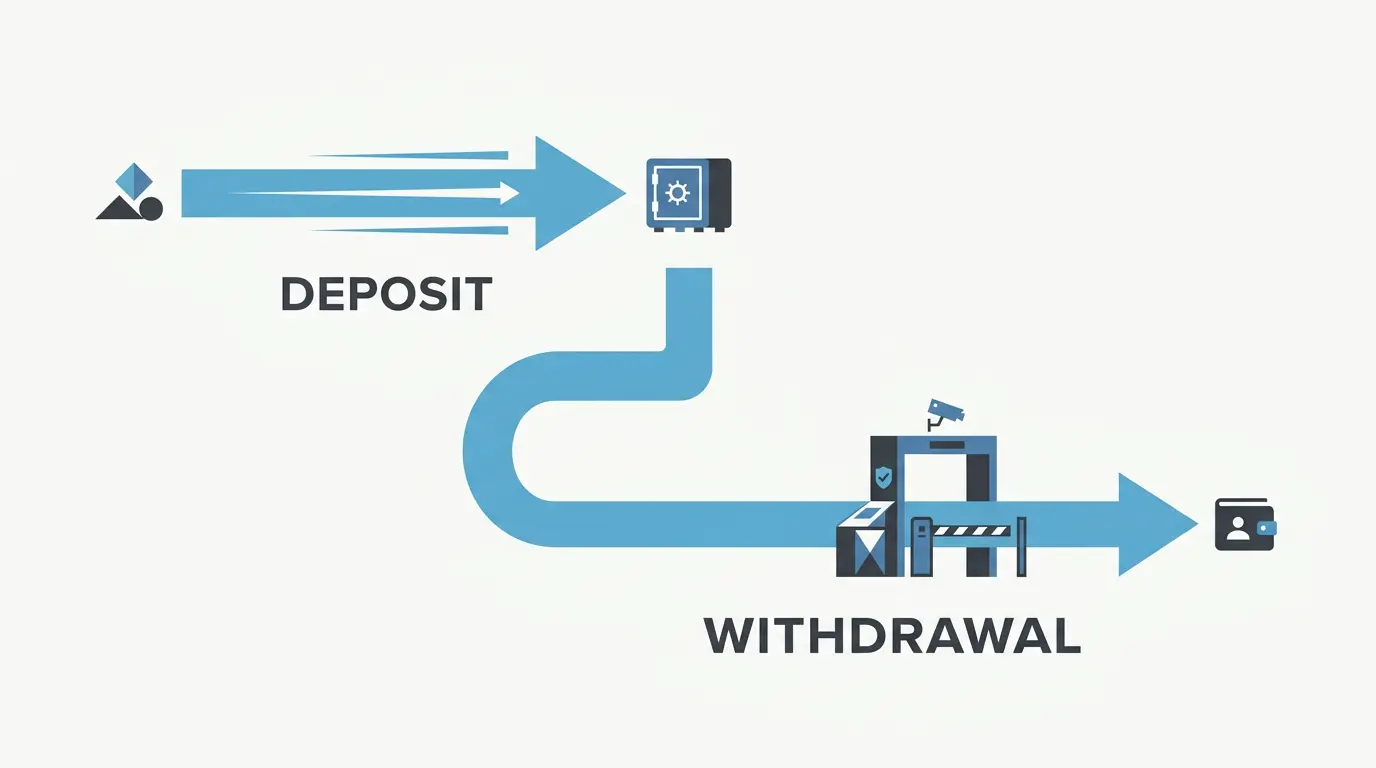
The withdrawal side is where the asymmetry lives, and it's the single most misunderstood thing in this niche. A PayID deposit and a PayID withdrawal are not mirror images. Depositing is a one-step push from you to the casino. Withdrawing runs the opposite direction and passes through the operator's own process first: a request, an approval queue, often an identity check, sometimes a deliberate pending window, and only then the payout. The NPP rail underneath is identical and just as fast in both directions. What differs is everything the casino bolts on top before it lets the money leave.
| Characteristic | PayID deposit | PayID withdrawal |
|---|---|---|
| Direction of money | You to casino | Casino to you |
| Who controls the speed | The rail — near-instant | The operator's approval process |
| Typical support | Almost universal where PayID is offered | Far less common; often replaced by bank transfer |
| Identity check likely | Rarely at this step | Frequently, especially on a first payout |
| Realistic timing | Seconds to minutes | Minutes to several days, depending on the queue |
This is why I'm allergic to the phrase "instant withdrawal" as a selling point. The rail is instant. The casino's decision to release your money is not, and no payment method can change that, because the delay isn't technical — it's procedural. When a payout takes two days, the funds didn't crawl through some slow pipe; they sat in an approval queue and then cleared in seconds once someone pressed go.
The rail moving your deposit is the same one carrying more than 35 percent of every account-to-account payment in Australia. Your casino top-up rides the identical infrastructure as someone's rent, payroll or tax refund — it isn't a special "gambling" pipe.
There's also the quiet substitution that catches people out. A casino can advertise PayID, accept your PayID deposit without a hitch, and then pay your winnings back as a generic bank transfer that lands a day or two later. Technically it accepted PayID; practically, you never got a PayID payout. This isn't necessarily a scam — it's often just how the operator configured its cashier — but it's why "accepts PayID" and "pays out by PayID" are two different claims to check separately before you deposit a cent.
For the overview, that's the shape of it: deposits are fast and reliable, withdrawals are gated by the operator, and "instant" describes the rail rather than your experience. The granular detail — the step-by-step payout timeline, why first withdrawals run slower, how weekends and verification holds stretch the clock, and what to do when a payout comes back as a bank transfer — is deep enough to deserve its own treatment, which is what I unpack in the breakdown of how PayID casino withdrawals are actually processed and timed.
Is PayID safe for casino payments?
Whenever someone asks me if PayID is safe, I ask them to finish the sentence: safe from what? The honest answer splits cleanly in two, and almost every misleading thing written about PayID safety comes from blurring the halves together. The rail itself is about as safe as a consumer payment can be in this country. The casino you're sending money to is a completely separate question, and it's the one that should actually worry you.
Start with what the rail genuinely protects. You never expose your full account and BSB to the merchant. The transfer is account-to-account, traceable, and run by your own bank rather than a third-party processor in the middle. And there's now a name-check layer that didn't exist a few years ago: Confirmation of Payee shows you the registered name attached to a PayID before you confirm, so if it doesn't match who you think you're paying, you get a beat to stop.
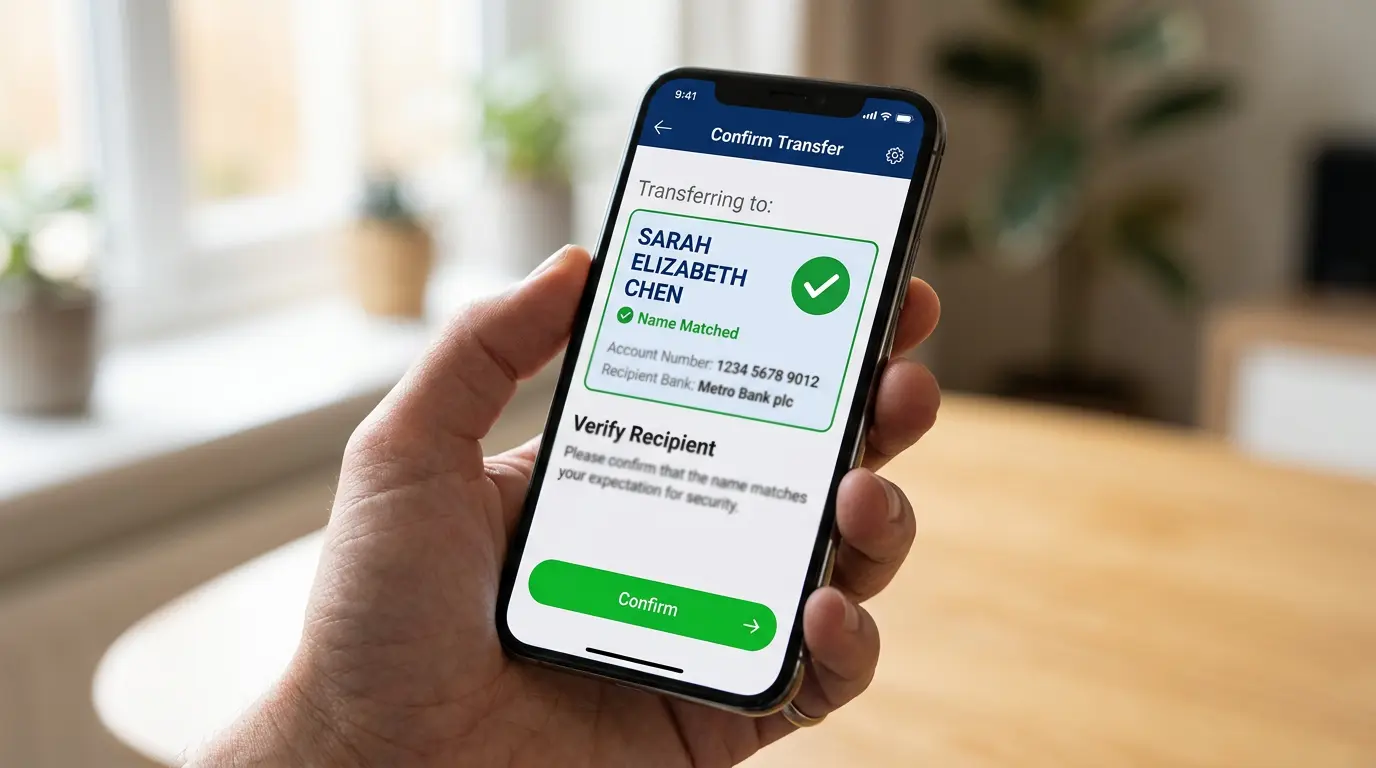
Confirmation of Payee — a name-checking feature that displays the account holder's registered name when you enter a PayID or account details, letting you catch a mismatch before money leaves your account.
The early evidence that this works is striking. Confirmation of Payee was used more than 100 million times in the months after its July 2025 launch, and research into name-checking found one in four people stopped or changed a payment once they saw the recipient's name. Overseas, where a comparable system has run longer, impersonation fraud fell by around 81 percent after name-checking went in. Australian Payments Plus set a target of near-universal coverage — above 95 percent of personal accounts — by December 2025, making this protection the default rather than the exception.
1 in 4
Payers who stopped or adjusted a transfer after seeing the recipient's name — the core reason name-checking blunts impersonation scams.
Now the other half. None of that protects you from an operator that simply decides not to pay you, or vanishes, or was never reachable to begin with. Name-checking confirms the money went where you addressed it; it says nothing about whether the address belongs to an honest business. The scams that do target PayID live in impersonation rather than the rail being broken — fake payment requests, people posing as a buyer or a support agent. Scamwatch reported around A$260,000 lost to PayID impersonation scams in a single year, and those losses come from social manipulation, not a flaw in how PayID moves money.
Do
- Read the name your bank shows you before confirming any transfer.
- Get the PayID details from inside the casino cashier, not a chat message or email.
- Treat the operator's legitimacy as a separate check from the payment's safety.
Don't
- Pay a PayID someone sends you unsolicited, however urgent the story sounds.
- Assume a successful deposit means the casino will pay you back.
- Confuse "the rail is secure" with "this site is trustworthy."
So the verdict is reassuring on one axis and cautious on the other. The PayID rail is well built and getting better, with name-checking now baked in; the operator risk is the part PayID can't touch, and it's where your attention belongs. The full treatment — how name-check handles match, close-match and no-match cases, the real scam numbers, and how impersonation schemes are run — is set out in the deeper look at whether PayID is genuinely safe for online casino play.
Is using PayID at casinos legal in Australia?
This is the question the affiliate listicles tiptoe around, and the silence is doing readers real harm. So I'll say the uncomfortable part first and then explain it. Online casinos are not licensed in Australia. The sports betting sites advertised during the footy are licensed; the online pokies and table-games casinos that accept PayID are, as a rule, offshore operators serving Australians from outside the country's regulatory reach.
The line is drawn by the Interactive Gambling Act 2001. It permits certain regulated activities — licensed wagering on sport and racing, lotteries — while prohibiting the provision of online casino-style gaming to people in Australia. That's why a bookmaker can run glossy local ads and an online casino cannot. They are not the same category of business in the eyes of the law, even though both involve gambling and both might accept PayID. Confusing the two is the most common mistake I see, and it's an expensive one to make.

Licensed wagering and online casino gaming sit on opposite sides of the same Act. A licensed Australian bookmaker operates legally and locally. An online casino offering pokies and table games to Australians operates outside that licensing framework — which is why these casinos are based offshore. PayID doesn't change which side of the line a site sits on.
The regulator with the teeth here is ACMA, and it has been busy. Since November 2019 it has had 1,455 illegal gambling and affiliate websites blocked, and the enforcement isn't slowing. In a single quarter of 2025 it actioned 292 of 330 reports, opened 20 investigations, issued 10 formal warnings, and identified 73 sites breaching the law. ACMA also enforced a ban — effective 11 June 2024 — stopping licensed operators from accepting credit cards, credit-based products and cryptocurrency, and judged compliance with it as "very high." The direction of travel is unmistakable: tighter, not looser.
"This year marks a regulatory shift — from regulation that primarily checks for compliance to one focussed on substantive risks and harms." — Brendan Thomas, CEO, AUSTRAC
That shift matters for how you read the whole market. As regulators move from box-ticking toward chasing actual harm, the offshore casinos PayID players use sit squarely in the path of an enforcement machine getting sharper every year. The protective scaffolding around legal gambling is being built up too — the National Self-Exclusion Register, BetStop, held almost 45,000 self-exclusions as of 30 June 2025 — while the offshore casino sector remains outside those protections by design.
Now, the question players actually want answered: where does this leave me? Here's the careful version, and it's careful because this is legal context, not legal advice. The Act targets the operators who provide illegal services, not the individuals who play on them. The practical risks you carry are different in kind — a blocked site you can no longer reach, a balance stranded with an operator that exits the market, an offshore company you have no local recourse against if it refuses to pay. PayID makes none of those risks worse, but none of them go away either; it confers no legality on the site receiving the money.
Using PayID at an offshore casino does not make that casino legal, and it does not make you a licensed gambler. The legal exposure sits with the operator, but the practical exposure — no local recourse, possible site blocking, stranded funds — sits with you. Going in clear-eyed about that is the whole point of reading this section.
I've kept this to the contours because the legal detail genuinely deserves room to breathe — what the Act bans clause by clause, how the casino-versus-wagering split plays out, what site blocking means for a player mid-balance, and exactly where individual liability begins and ends. All of that lives in the full explainer on the legal status of PayID casinos under Australian law.
The harm context Aussie players should know
I'll be honest about why this section exists, because most sites in this space leave it out entirely. A page that explains how to move money into a casino without being straight about what that money does is only telling you half the story. Australians are, by a wide margin, the heaviest gamblers on earth per head, and the numbers behind that are not abstract.
In the 2022-23 financial year, Australians wagered a record A$244.3 billion on legal forms of gambling, up more than 18 percent on the year before. The net losses from that — money that left players and didn't come back — came to A$31.5 billion. Spread across the adult population, average losses landed somewhere around A$1,200 to A$1,555 per adult, the highest per-capita gambling losses anywhere in the world. That's a national habit running at a scale no other country comes close to.

A$31.5 billion
Net gambling losses by Australians in FY2022-23 — money that left players' pockets — against a record A$244.3 billion wagered.
What makes the recent data genuinely concerning is a divergence that shouldn't happen. Overall participation in gambling has been drifting down for years and sat at 58.8 percent in 2025. And yet the share of people gambling at risky levels jumped from 13.7 percent in 2024 to 19.4 percent just twelve months later — close to a doubling since the lockdown period. The crowd is thinning while the intensity among those who remain is climbing. The researchers behind that work — Aino Suomi, Markus Hahn and Nicholas Biddle at the Australian National University — put the implication plainly, noting their "findings highlight intensifying harm despite declining participation, highlighting a critical need for regulatory and public health responses targeting online gambling."
That last phrase is what connects back to PayID. The harm is concentrating online, in the same channel where PayID is the smooth, frictionless way to keep topping up — a rail that settles in seconds and never sees your card is a convenience when you're in control and a hazard when you're not.
I'm not in the business of lecturing anyone out of an adult choice, and that's not what this is. It's context you can't get from a page that only wants you to deposit. If the speed ever starts to feel like the point rather than the tool, that's the signal worth heeding — and the formal supports, from deposit limits to the national self-exclusion register, exist precisely for the moments when self-management isn't enough.
Australia leads the world in gambling losses per adult, and the harm is concentrating in exactly the online channel PayID serves. Fewer people are gambling, but those who do are increasingly doing so at risky levels. The speed that makes PayID convenient also removes the friction that once slowed an impulse — worth knowing before you treat it as purely a feature.
Money laundering, KYC and why operators ask for ID
The single most common complaint I hear about PayID casinos isn't about speed or fees — it's "why do they suddenly want my ID before they'll pay me?" The frustration is real, and the answer sits in a part of the system most players never think about until it's blocking their withdrawal. Gambling and money laundering are old companions, and the checks that annoy you exist because regulators treat the gambling sector as a known weak point.
The scale is sobering. Serious and organised crime costs Australia more than A$68 billion a year, in the words of AUSTRAC chief executive Brendan Thomas, who has been blunt that "some industries, like the gambling industry, are frequently at the coalface of criminal infiltration." A NSW Crime Commission investigation concluded that a significant chunk of the roughly A$95 billion fed through that state's poker machines in a single year was likely the proceeds of crime — laundered through the act of gambling itself.
KYC — Know Your Customer, the identity-verification process operators and financial institutions run to confirm who you are, typically triggered at withdrawal to satisfy anti-money-laundering obligations.
Enforcement has teeth on this front too. In July 2025, AUSTRAC launched Federal Court proceedings against a major clubs group operating around 1,400 poker machines across eight venues, over systemic anti-money-laundering failures. When the regulator is willing to take a large, established operator to court, the message to the rest of the sector is that identity and source-of-funds checks are not optional paperwork — they're the price of staying in business.
So when a casino freezes your withdrawal pending verification, you're seeing this machinery in action, even at an offshore operator nominally outside Australian licensing. Many still run KYC because their own payment partners and banking relationships demand it. The check that feels like a hurdle is, in part, the system working as designed.

A verification request at withdrawal isn't necessarily a stalling tactic — it's usually the anti-money-laundering layer doing its job. The practical lesson is to verify early, before you have winnings waiting, so the check happens on the operator's clock rather than yours. A casino that never asks for ID isn't being generous; it may simply be ignoring obligations that catch up with everyone eventually.
The takeaway here is a reframe: KYC is friction with a purpose, and the operators that skip it entirely are showing you something about themselves. An early, well-run verification process is a mild positive signal — evidence the operator is plugged into the financial system rather than dancing around its edges.
PayID vs crypto, POLi and bank transfer
Players ask me to crown a winner here, and I refuse, because it's the wrong frame. PayID, crypto and an old-fashioned bank transfer aren't three grades of the same thing — they're three different answers to three different questions. POLi, the bank-login method some players still ask about, has effectively left the picture, which leaves these three as the live comparison.
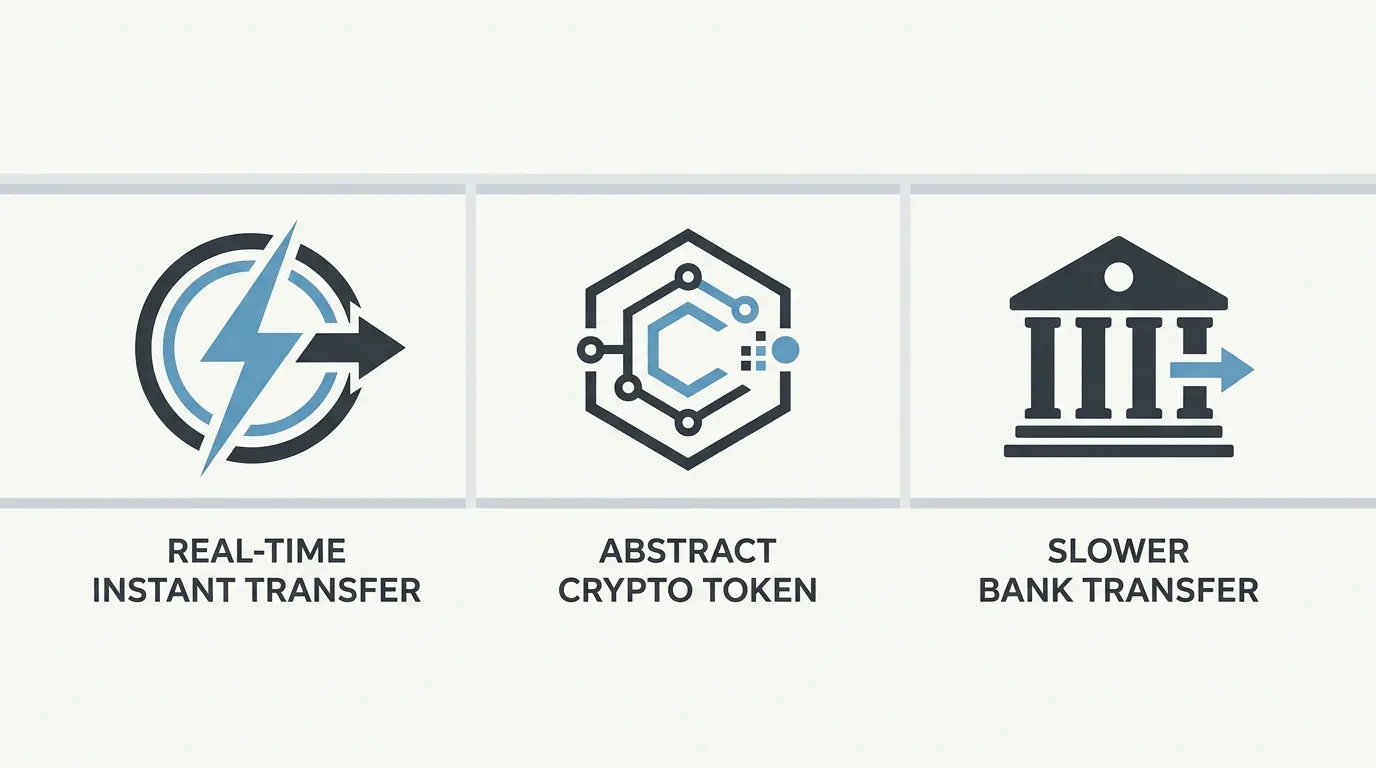
Let me set the rough shape before the detail, because the broad strokes already settle most decisions. PayID is the regulated, AUD-denominated, real-time option your bank stands behind. Crypto is the pseudonymous, volatile alternative carrying its own custody and price risk. A plain bank transfer is the slow, reliable fallback that works everywhere but lacks the speed. The differences that matter most are speed, cost, privacy, and the legal backdrop — and on the last of those, the three options genuinely diverge.
| Axis | PayID | Crypto | Bank transfer |
|---|---|---|---|
| Settlement speed | Real-time | Minutes to hours, network-dependent | Slow, often a day or more |
| Currency | AUD throughout | Volatile token, converted | AUD throughout |
| Value stability | Stable | Can move while you transact | Stable |
| Bank-backed | Yes | No | Yes |
| Name-check protection | Yes | No | Increasingly |
The cost story favours the real-time rails decisively. The wholesale cost of an NPP transaction fell to roughly A$0.04 by the 2025 financial year, which is why PayID transfers are typically free to you at the consumer level. Crypto, by contrast, carries network fees that swing with congestion, plus the spread you pay converting in and back out of a volatile token — and that token can lose value in the window between requesting a payout and receiving it, a risk AUD options simply don't have.
Choose PayID for
Speed and stability in AUD, with your bank's name-check and recourse behind every transfer.
Crypto trades speed for
Pseudonymity, at the cost of volatility, custody risk and no name-check safety net.
The legal divergence
Licensed Australian operators have been barred from accepting crypto since 11 June 2024 — a clear regulatory signal about where it sits.
That last point is the one most comparisons miss. Since 11 June 2024, licensed operators in Australia have been prohibited from accepting cryptocurrency, which tells you how the regulator views it in this context regardless of any technical merits. PayID carries no such cloud. For an Australian player who wants AUD in, AUD out, settled fast and backed by a real bank, PayID is the natural fit — and that's the overview. The full axis-by-axis comparison, including where crypto's pseudonymity genuinely helps and where it bites, is laid out in the head-to-head on how PayID stacks up against crypto for casino payments.
Which Australian banks support PayID
The shortest true answer to this question is also the most useful one: if your bank is part of the New Payments Platform, it supports PayID, and almost every bank you've heard of is. I get asked to name the big four versus the neobanks versus the credit unions, but that granularity mostly misses the point. PayID isn't a feature one bank bolted on to compete; it's a shared piece of national infrastructure that participating institutions plug into.

The coverage numbers make this concrete. By the end of 2022, more than 100 financial institutions and 12.7 million Australians had registered PayIDs, and that base has only grown — more than 25 million PayIDs were registered by April 2025. When registration is that widespread, the realistic assumption is that your everyday bank account can already create and use a PayID. The exceptions are rare enough to be the thing you check, not the rule you plan around.
NPP — the New Payments Platform, the shared national infrastructure for real-time account-to-account payments that PayID runs on. A bank that participates in the NPP can offer PayID.
What actually varies between banks isn't whether PayID exists but the small mechanics around it — what kinds of alias you can register, how many, and how quickly a new PayID becomes usable. Some institutions let you register both a phone number and an email; some impose a short cooling-off window on a new PayID before it can send larger amounts, as a fraud-control measure. None of that changes the core fact that the rail is there and works the same way once it's set up.
The rule
If your bank is on the NPP, it supports PayID. That covers the overwhelming majority of Australian accounts.
What varies
Alias types allowed, how many you can hold, and any short activation delay on a new PayID.
What doesn't
The underlying rail and its real-time speed — identical across every participating institution.
So rather than memorising a list, treat bank support as a near-given and spend your attention on the operator instead. Open your banking app, confirm a PayID is registered to the account you'll use, and you've done the only bank-side check that matters.
Fees, limits and the real cost of PayID
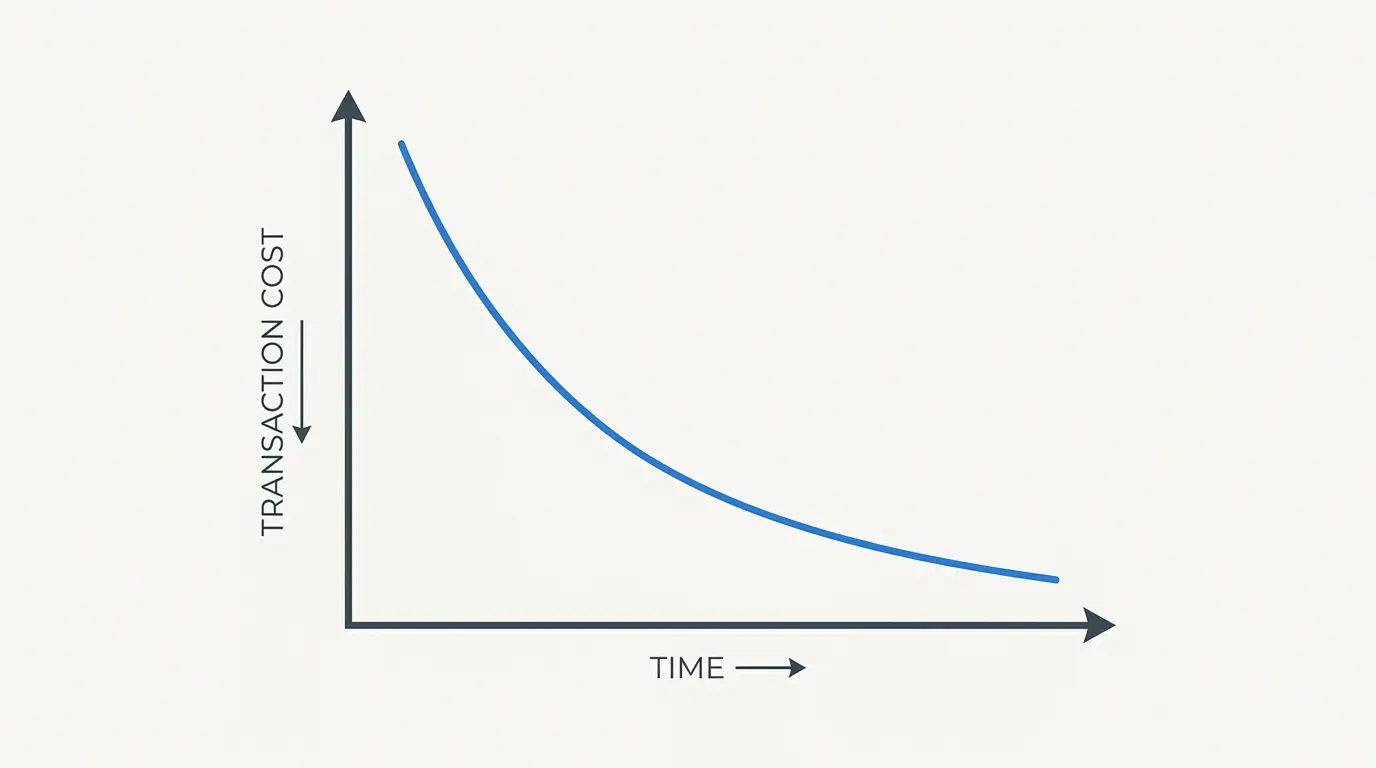
Here's a number that reframes the whole fee conversation: by the 2025 financial year, the wholesale cost of pushing a single transaction across the NPP had fallen to roughly A$0.04, down from about A$0.39 in 2019. Four cents. That collapse is the reason PayID transfers are almost always free to you as a consumer — when moving money costs banks a rounding error, there's simply nothing to pass on at the personal level. So the honest headline is that the rail itself doesn't cost you anything to use.
A$0.04
The wholesale cost per NPP transaction by FY2025, down from A$0.39 in 2019 — why PayID transfers carry no fee for the everyday user.
But "PayID is free" and "playing costs you nothing" are different claims, and the real costs hide in two places that have nothing to do with the rail. The first is currency. If a casino settles your account in something other than AUD, every deposit and withdrawal can quietly bleed a conversion margin — not a PayID fee, but a cost from how the operator handles money. An AUD-throughout operator avoids this entirely.
The second is limits, and these are where the friction you'll actually feel lives. PayID and your bank may impose daily transfer caps, and a newly registered PayID can carry a temporary lower ceiling as a fraud safeguard. On top of that, the casino sets its own deposit and withdrawal limits and minimums. None of these are fees in the strict sense, but they shape your experience just as much — a generous deposit limit paired with a stingy withdrawal cap is a pattern worth noticing before you commit.
The PayID rail is free to use, so any cost you encounter comes from elsewhere: a non-AUD operator skimming on conversion, your bank's transfer caps, or the casino's own limits and minimums. When something feels expensive about a PayID casino, the rail is almost never the culprit — look at the currency and the operator's terms instead.
So the real cost of PayID is zero at the rail and variable at the edges. Never blame PayID for a charge that's actually a conversion margin or a limit, and read the operator's terms with the same care you'd give the bonus fine print. The cheapest setup is the boring one — an AUD account, a bank with sensible caps, and an operator whose limits you've read in advance.
PayID casino questions, answered
After nine years fielding the same handful of questions, I've learned which ones actually trip people up. These are the seven I'm asked most, answered the way I'd answer a mate over coffee.
A theme runs through all of these: the PayID rail is rarely the problem. Almost every real-world snag — a slow payout, a verification hold, a stranded balance — traces back to the operator's choices, not to how PayID moves money.
What is a PayID casino and how do the payments work?
It's an ordinary online casino that accepts PayID, not a separate type of site. You link a simple identifier — your phone number or email — to your bank account, then pay the casino's PayID alias from your banking app. The money settles in real time, in Australian dollars, without you handing over your full account and BSB details. The rail underneath is the same New Payments Platform that carries a huge share of everyday Australian payments.
Is PayID safe to use at online casinos?
The rail is safe by design — you don't expose your bank details to the merchant, and name-checking now shows the recipient's registered name before you confirm, which research found prompts one in four people to stop or adjust a payment. What PayID can't make safe is the operator. A secure payment to an untrustworthy offshore casino is still a payment to an untrustworthy casino, so treat the rail's safety and the operator's trustworthiness as two separate checks.
How long does a PayID withdrawal take?
The rail clears in seconds, so any wait is the casino's doing, not the network's. Your request joins an approval queue, may trigger an identity check, and sometimes sits in a deliberate pending window before release. First withdrawals run slowest because verification often happens then. Realistically that's anything from minutes to several days depending on the operator — and some casinos don't pay out by PayID at all, returning funds as a slower bank transfer instead.
Are there any fees for PayID deposits or withdrawals?
Not from the rail itself. The wholesale cost of an NPP transaction has fallen to around four cents, so PayID transfers are typically free to you. Any cost you encounter comes from elsewhere — a casino that settles in a currency other than AUD and skims on conversion, your bank's transfer limits, or the operator's own minimums. If a PayID casino feels expensive, look at the operator's currency handling and terms, not the rail.
Is it legal to use PayID at online casinos in Australia?
This is the part most sites avoid. Online casinos are not licensed in Australia under the Interactive Gambling Act 2001, which is why the ones accepting PayID are almost always offshore — unlike licensed sports betting, which is legal and local. ACMA has had 1,455 such sites blocked since 2019 and barred licensed operators from accepting credit cards and crypto from 11 June 2024. The Act targets operators rather than players, but using PayID doesn't make an offshore casino legal, and it leaves you no local recourse if things go wrong.
What payment options can PayID replace at a casino?
PayID slots in wherever you'd otherwise reach for a real-time AUD transfer — the fast, bank-backed, account-to-account option. Against a plain bank transfer it wins on speed; against crypto it trades pseudonymity for stability, AUD certainty, and your bank's name-check protection. Crypto in particular carries volatility and custody risks that AUD rails don't, plus a regulatory cloud since licensed operators were barred from accepting it in 2024.
Which banks support PayID?
Effectively all of them. If your bank participates in the New Payments Platform — and the overwhelming majority do — it supports PayID. More than 100 financial institutions had it by the end of 2022, and over 25 million PayIDs were registered by April 2025. What varies is minor: the alias types you can register, how many, and whether a new PayID has a short activation delay. The simplest check is to open your banking app and confirm a PayID is linked to the account you'll use.
The bottom line on PayID casinos
If you remember one sentence from this entire page, make it this: PayID is the easy part. After nine years watching this market, what still strikes me is how much energy gets spent on the payment method — mature, fast, free and genuinely well protected — and how little gets spent on the operator, which is where every real risk lives.
The rail is mainstream infrastructure: more than 27 million PayIDs, real-time settlement on a platform moving trillions a year, name-checking now built into transfers. What's in question, every single time, is the casino on the receiving end — whether it's legal, whether it pays out through PayID or just takes deposits, whether it'll still be reachable next month, and whether you'll have any recourse if it isn't. Those are operator questions, and PayID answers none of them.
So the move is simple to state and harder to practise. Trust the rail, vet the operator, and keep the legal and harm context in view rather than out of mind. The offshore reality, the enforcement that keeps tightening, the harm data climbing in the online channel — these aren't reasons to panic, they're reasons to go in clear-eyed.
PayID is the safe, settled, well-understood half of the equation. Put your scrutiny where it belongs — on the operator, its legality, and its willingness to actually pay you. Get that habit right and you've solved the only part of this that was ever genuinely risky.