
PayID vs POLi for Casino Payments
 Available in US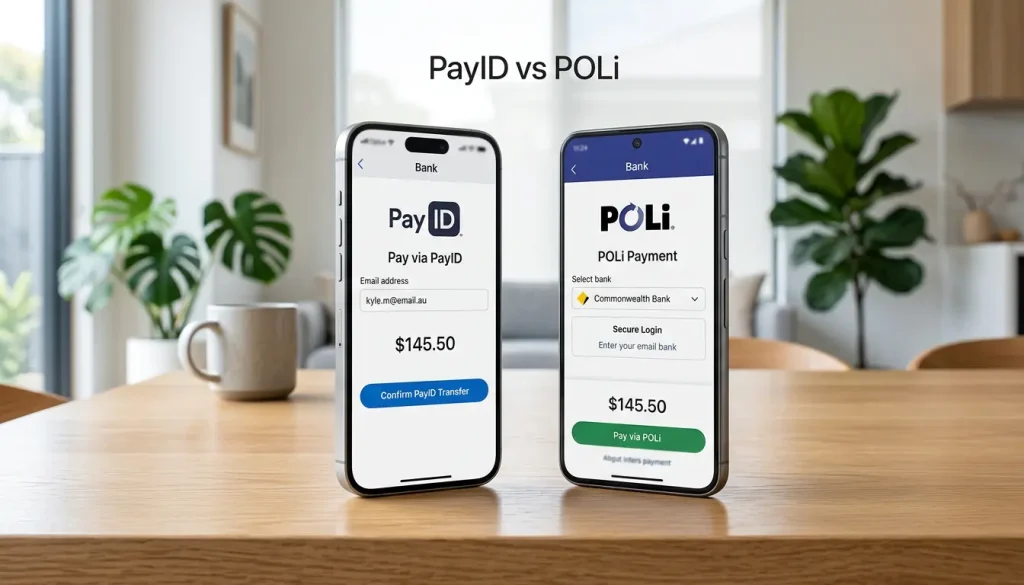
PayID and POLi: two Aussie bank methods
For a long time, if an Australian wanted to fund an account straight from their bank without a card, POLi was the answer. Then PayID arrived and changed the calculus entirely. Both are home-grown, account-based ways to pay, but they work in fundamentally different ways, and the difference has real consequences for security and reliability.
Table of Contents
The core distinction is this: PayID runs over Australia’s real-time payment infrastructure using a simple alias and a name check, while POLi works by redirecting you into your bank’s login page so it can complete a transfer on your behalf. One sends money from your own banking app on instant rails; the other inserts a third party into the login step. That structural difference is the whole story, and it explains why I treat them very differently.
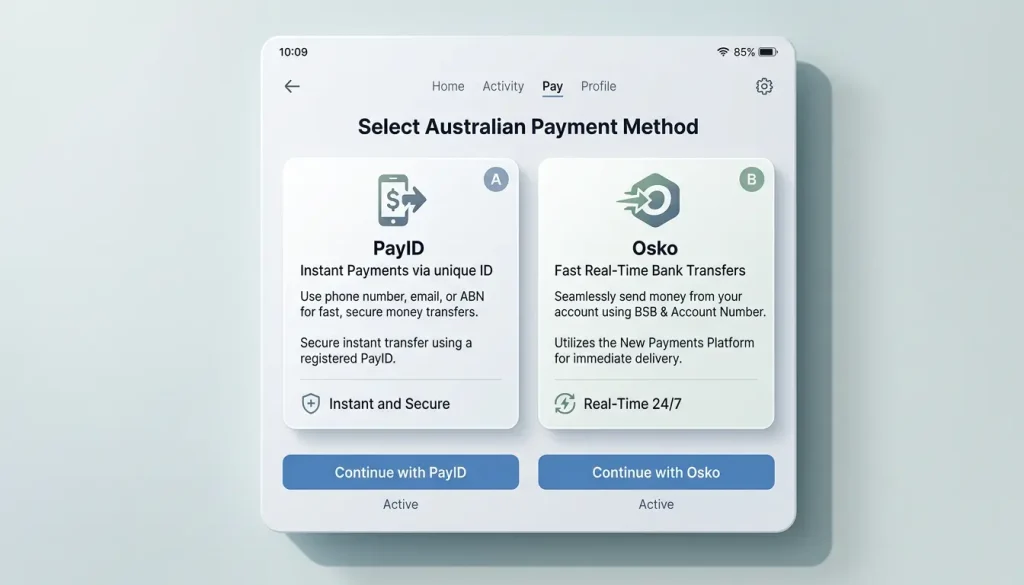
This piece compares the two on how each actually moves your money, how they stack up on speed and security, and which makes more sense for casino play today. I will be direct about the trade-offs rather than diplomatic – the methods are not equivalent, and pretending they are would not help you. Both keep you off credit cards, which matters in the current Australian environment, but the way they each do it is where the comparison gets interesting.
How each moves your money
The clearest way to compare PayID and POLi is to follow a single payment through each, step by step, because the mechanics diverge almost immediately and everything else flows from there.
With PayID, you stay inside your own banking app the entire time. The casino gives you an alias to pay; you open your bank’s app, choose to pay a PayID, enter the alias, see the name check confirming who you are paying, and authorise the transfer. The money moves directly from your account over the New Payments Platform, which carries more than 35% of all account-to-account transactions in Australia. At no point does any third party touch your login. You are the only one who ever enters your banking credentials, into your own bank’s app.
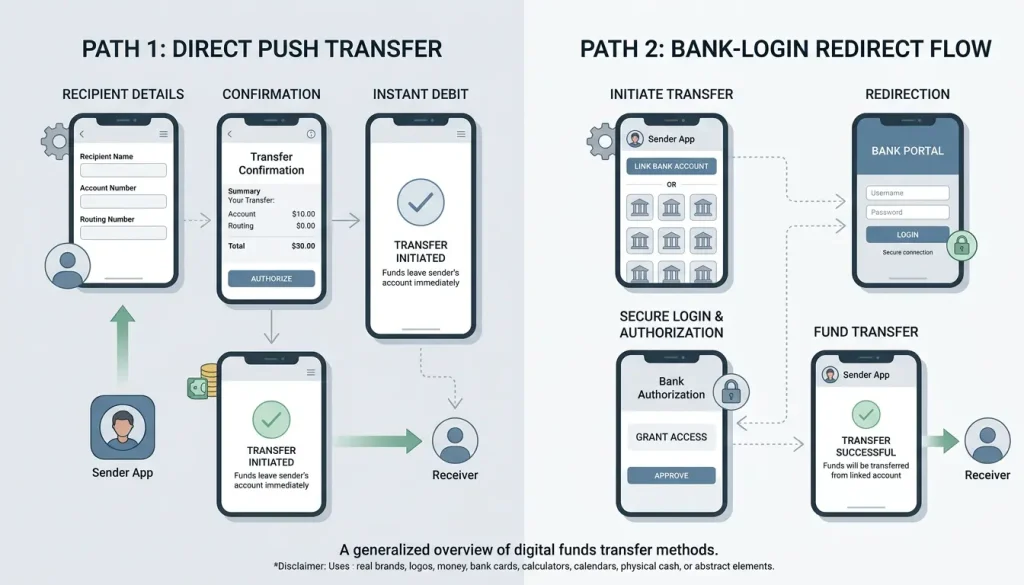
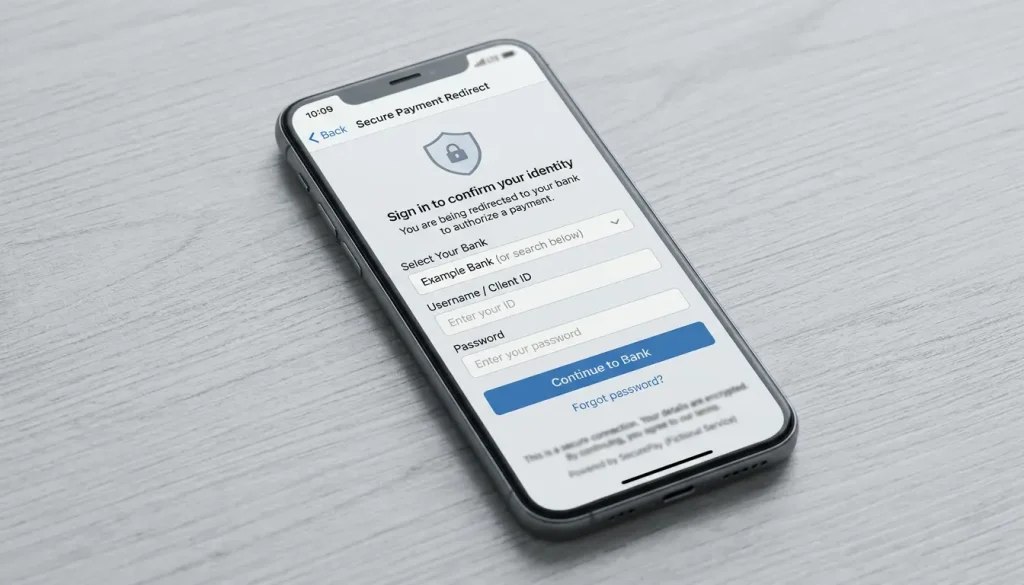
With POLi, the flow is structurally different. Instead of staying in your banking app, you are redirected to a POLi-hosted page that presents your bank’s login, and you enter your internet banking credentials there so POLi can initiate the transfer on your behalf. It then completes a bank transfer to the merchant and confirms it back to the casino. The convenience is that it works without you needing a registered alias, but the mechanism involves entering your bank login into an intermediary’s flow rather than your bank’s own app. That single architectural choice – credentials into your own app versus credentials into a redirect – is the fork from which every security and reliability difference grows. It is worth pausing on, because it is the thing the two methods most genuinely disagree about.
Speed, security and reliability compared
When you line the two up on the axes that actually matter – speed, security, and reliability – PayID comes out ahead on each, and not by small margins. I want to explain why rather than just assert it.
On speed, PayID settles in real time over the NPP, typically in seconds, around the clock. POLi initiates a bank transfer that, depending on the banks and timing involved, may not settle with the same instant, guaranteed immediacy – the experience can be quick but is not built on the same continuously-settling rail. On cost, the underlying PayID infrastructure is extraordinarily cheap, with wholesale transaction costs down to around A$0.04, which is part of why PayID transfers are typically free to the player.
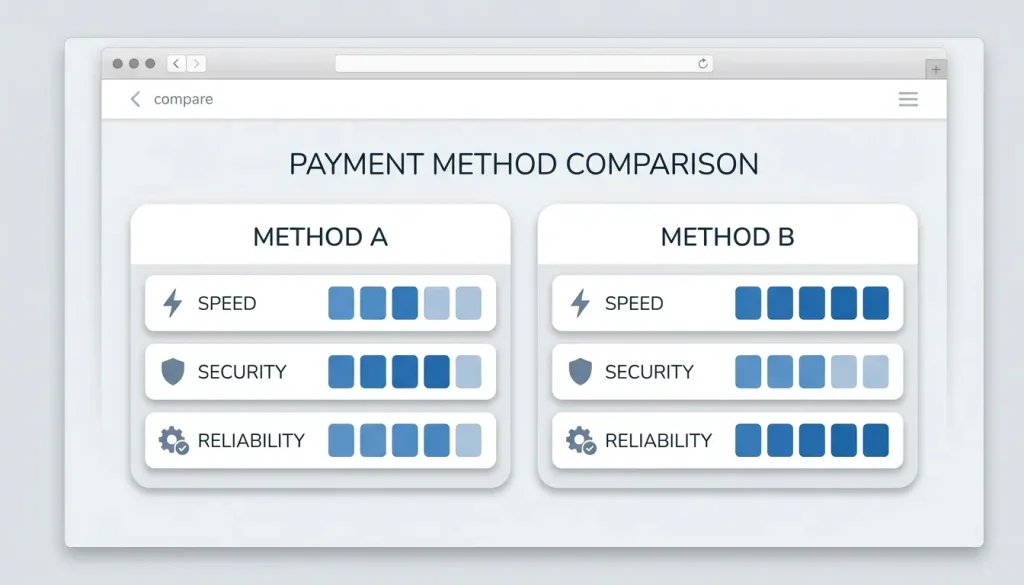
On security, the difference is the one I weigh most heavily. PayID never asks you to enter your banking credentials anywhere except your own bank’s app, and it adds a name check that shows you who you are paying before you confirm – a built-in defence against sending money to the wrong place. A redirect-based method that involves entering your internet banking login into an intermediary’s flow asks for a different and, to my mind, larger trust. The principle that matters here is simple: the fewer places your banking login is ever typed, the smaller your exposure, and PayID keeps that number at one – your own bank.
On reliability, PayID benefits from being native infrastructure with broad bank participation, whereas redirect-based screen-scraping approaches have historically been more sensitive to changes in banks’ login pages and security measures. When a bank updates its login screen, a method that depends on reading that screen can break until it is patched, while a method built into the bank’s own systems simply keeps working. The honest summary is that PayID was designed as core payment infrastructure, while POLi was a clever workaround built before that infrastructure existed – and infrastructure tends to beat workarounds on exactly these axes over time.
Which suits casino play today
If you are choosing between the two for funding a casino account right now, my recommendation is straightforward, but I want to give you the reasoning rather than just the verdict so you can weigh it for your own situation.
For most Australian players today, PayID is the better fit for casino payments. It is faster in a guaranteed way, it keeps your banking credentials confined to your own bank’s app, it gives you a name check before you commit, and it is typically free. The only real requirement is that you have a registered PayID, which takes a couple of minutes to set up once. Against that, the case for a redirect-based method is mainly that it can work without a registered alias – a convenience that matters less once you have spent the two minutes to register one.

There is also a practical availability question worth checking for yourself, since the payments landscape shifts and a method that was widely offered in the past may be less so now. Rather than rely on a general claim, confirm what your specific operator actually supports at its cashier. But on the merits, the structural advantages of paying from inside your own banking app, on real-time rails, with a name check, are durable ones that do not depend on any operator’s current menu. For a broader look at how PayID stacks up against fundamentally different payment models, including crypto, our guide to PayID versus crypto casinos takes the comparison further. For the bank-to-bank choice specifically, though, PayID is the one I reach for.
Frequently Asked Questions
Is POLi still widely available?
Availability varies and the payments landscape shifts over time, so a method offered widely in the past may be less common now. The reliable approach is to check what your specific operator actually supports at its cashier rather than assuming, since deposit menus differ from one casino to the next.
Is one safer than the other?
PayID keeps your banking credentials confined to your own bank's app and adds a name check before you confirm a payment, whereas a redirect-based method involves entering your internet banking login into an intermediary's flow. That structural difference is why many players consider the alias-and-name-check approach the more cautious choice.
Does either share my bank login?
With PayID you enter your credentials only into your own bank's app, so no third party handles your login. A redirect-based method asks you to enter your internet banking login into its flow to complete the transfer, which is the main trust difference between the two approaches.
Guides
Protecting Yourself From PayID Scams
Protecting yourself from PayID scams Here is the single most useful thing I can tell you about PayID scams: almost none of them involve hacking the payment system. The rail…
Why ACMA Blocks Casino Sites
Why ACMA blocks casino sites If a casino site you have used…
Why PayID Casinos Ask You to Verify Your Identity
Why PayID casinos ask you to verify The first time a casino…
How Anonymous PayID Really Is at a Casino
How anonymous PayID really is I get asked whether PayID lets you…
The Minimum Deposit at a PayID Casino, Explained
The lowest you can deposit with PayID The smallest PayID deposit I…