
How I Judge the Best PayID Casinos for Real Australian Players
 Available in US
What separates the best PayID casinos
The first time a reader emailed me asking why his “top-rated” PayID casino had quietly switched him to a slow bank transfer for withdrawals, I realised most of the lists ranking these operators are answering the wrong question. They rank on bonus size. Nine years of watching real money move across NPP rails has taught me the only ranking that matters is whether the casino actually pays, and whether it pays the way it promised.
Table of Contents
So let me be blunt about the line I draw. The best PayID casinos are not the ones with the biggest welcome offers or the loudest “fastest payout” banners. They are the ones that support PayID on the way out, not just on the way in, and that settle disputes without making you chase them. That single distinction, deposit-only versus genuine two-way PayID support, sorts the serious operators from the rest faster than any bonus comparison ever will. It is also the distinction that affiliate listings ignore, because deposit-only operators convert just as well and pay affiliates the same commission.
There is a structural reason this matters more in Australia than almost anywhere else. PayID is a domestic real-time rail, built on the New Payments Platform, and the operators serving Aussie players are almost always offshore. That combination, a fast local payment method bolted onto a casino with no Australian licence, means your protection comes almost entirely from picking the right operator rather than from any regulator standing behind it. When the safety net is thin, the selection process has to be rigorous.
What follows is the method I actually use, broken into the criteria that survive contact with reality. I will not be naming a “top five,” because a ranked list goes stale the moment an operator changes its terms, and because handing you a list teaches you nothing about how to judge the next casino you encounter. Instead I am going to hand you the scoring framework, the trust signals worth trusting, and the red flags that knock an operator off my consideration set entirely. By the end you should be able to vet a PayID casino yourself in about twenty minutes, which is the only skill that genuinely protects you.
The scoring method behind this list
I once spent a fortnight depositing small amounts into eleven different operators just to map how long each took to return money via PayID versus how long their landing pages claimed. The gap between marketing and measurement was the whole story. That experiment became the backbone of how I weight things now, because a scoring method is only honest if it measures what the player experiences, not what the operator advertises.
My framework runs on five weighted pillars, and the weighting is deliberate. Payout behaviour carries the most weight because it is the thing that fails when it matters most, the moment you have actually won. Licensing and audit signals come next, because they predict how an operator behaves under pressure. Then comes the honesty of the terms, the quality of support, and finally the surface stuff like bonus value that most lists put first. If an operator aces the bonus and fails the payout, it scores near zero in my book, full stop.

The reason I lead with verification rather than reputation is the Australian regulatory backdrop. From the first blocking request in November 2019 through to the end of 2025, the communications regulator had moved against 1,455 illegal gambling and affiliate sites, and roughly 220 services chose to leave the market voluntarily rather than face enforcement. Any scoring method that does not check whether an operator sits on a public block list is missing a live signal that the operator may vanish, switch domains, or stop paying. So step one in my process is mechanical: cross-reference the operator against the regulator’s published list before I assess anything else.
Payout reliability and PayID-on-withdrawal
Here is the test that decides most of the score before I look at anything else: I deposit a modest amount, play it through, and request a withdrawal back to my PayID. What happens next tells me everything. A serious operator processes the cashout request, clears its internal approval window, and returns the funds to the PayID I deposited from. A deposit-only operator quietly informs me, usually buried in the cashier, that withdrawals go out by manual bank transfer instead, which adds days and reintroduces exactly the friction PayID was meant to remove.
The technical truth worth understanding is that the rail itself is never the bottleneck. NPP real-time settlement is genuinely fast, so when a PayID payout drags on for three days, the delay lives inside the casino’s approval process, not inside the payment network. I score operators on the predictability of that internal window, not on the headline speed claim. An operator that reliably approves within twenty-four hours beats one that advertises “instant” but reviews payouts on a Monday-to-Friday basis with no weekend processing.

This is where the deposit-versus-withdrawal split deserves a proper read, because the mechanics of how money leaves a casino are genuinely different from how it arrives, and most players only discover this after they win. I unpack the full payout timeline, the approval window, and why so many operators take PayID one way only in my breakdown of how PayID casino withdrawals actually work. If an operator cannot pass the round-trip test, no amount of polish elsewhere rescues its score.
Licensing, audits and operator trust signals
A licence number printed in the footer is the single most faked trust signal in this entire industry, and I learned to verify rather than trust the hard way after tracing a “Curaçao licensed” badge to a registration that had lapsed two years earlier. So when I talk about licensing as a trust signal, I mean the verifiable kind, checked at the source, not the logo in the footer.
The licences you will encounter with PayID casinos are overwhelmingly offshore, because no Australian online casino licence exists for this product. That is not automatically disqualifying, but it changes what the licence buys you. An offshore licence from a jurisdiction with an active complaints process and published enforcement actions is worth something. A licence from a jurisdiction that rubber-stamps anyone and never intervenes is worth almost nothing beyond decoration. The trick is knowing which is which, and the way you tell them apart is by looking at whether the regulator ever actually does anything.

Enforcement in Australia gives you a useful reference point for what real consequences look like, even though it targets licensed wagering rather than offshore casinos. The wagering operator Betchoice paid a one million dollar penalty and accepted a two-year commitment to independently review its systems, which is the kind of accountability a meaningful regulator imposes. The regulator’s own framing of where this is heading is instructive, with the financial intelligence chief describing the period as a regulatory shift “from regulation that primarily checks for compliance to one focussed on substantive risks and harms.” That phrase captures the test I apply to any operator’s licence: does the body behind it look at substance, or does it just check a box?
Beyond the licence, I weight three audit-adjacent signals. The first is independent game fairness testing, because a published RTP, the return-to-player percentage that tells you the long-run payout rate of a game, means nothing unless an outside lab has verified the random number generator behind it. The second is transparent ownership, a named parent company you can actually find, rather than a shell that dissolves the moment trouble arrives. The third is a real complaints trail, because an operator that has handled disputes in public and resolved them is a known quantity, whereas one with no history at all is a coin flip. I would rather back a casino with a handful of resolved complaints than one with a suspiciously spotless record, because spotless usually means new, and new means untested.
Red flags that drop a casino off the list
Some signals are not deductions. They are eliminations. Over the years I have built a short list of conditions that end my assessment immediately, no matter how good everything else looks, because each one predicts that the operator will fail you at the worst possible moment. Let me walk you through the ones that have proven most reliable.
The clearest external red flag is appearing on the regulator’s enforcement radar. In the second quarter of 2025 alone, the communications regulator assessed 292 of 330 complaints it received, opened 20 investigations, issued 10 formal warnings, and identified 73 sites that had breached the law. An operator showing up in that kind of enforcement activity is telling you, with a government rubber stamp, exactly how it behaves. I do not need to test a casino that a regulator has already flagged for breaching the rules.
The internal red flags are subtler but just as decisive. Shifting withdrawal terms after you deposit is a classic, where the cashout method or limit you agreed to quietly changes once your money is inside. Bonus terms that make withdrawal mathematically improbable are another, with wagering requirements set so high that the bonus functions as a lock on your own deposit rather than a gift. A support channel that answers instantly before you deposit and goes silent the moment you request a payout is the most human red flag of all, and the most common.

Then there are the structural warnings. An operator that accepts PayID for deposits but routes every withdrawal through a slower, less traceable method is signalling that it wants your money in fast and out slow. A casino that pressures you toward cryptocurrency for withdrawals “to avoid delays” is often steering you onto a rail with no reversibility and no name-check, which suits the operator far more than it suits you. And any site that cannot tell you, plainly, which entity holds your funds and under what licence has already failed the only question that matters when something goes wrong. I treat vagueness about ownership as a confession.
AUD handling, support and account terms
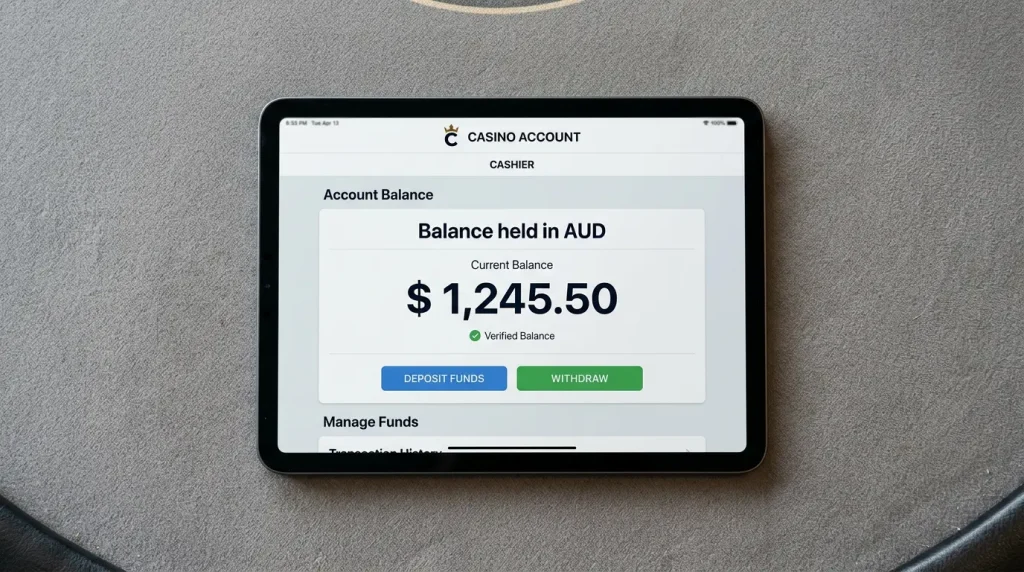
A reader in Perth once lost the better part of a withdrawal to currency conversion he never agreed to, because his “PayID casino” actually held balances in US dollars and converted twice, once on the way in and once on the way out. That single email reshaped how much weight I put on the boring operational details, because the boring details are where money quietly leaks.
The cleanest operators hold your balance in Australian dollars from deposit to withdrawal, which is what you would expect from a casino genuinely built around an AUD-only domestic rail. PayID itself is AUD-denominated and Australian by design, so an operator that takes your PayID deposit and immediately converts it into another currency has introduced a cost and a risk that has nothing to do with gambling and everything to do with the spread it earns on conversion. I check the cashier and the terms for the settlement currency before anything else, because no bonus offsets a conversion you did not consent to.
Support quality is harder to score but easy to test. I send a specific, slightly awkward question before depositing, something like how a pending PayID withdrawal is handled over a weekend, and I time the response and judge whether it actually answers or deflects. An operator that gives a precise, accurate answer about its own payout process is demonstrating two things at once: that it understands its own systems, and that it is willing to put commitments in writing. Vague reassurance is its own answer.
Account terms are the last layer, and the one players skip most. I read the sections on dormant account fees, withdrawal limits per day and per week, and the conditions under which an account can be frozen for review. These are not edge cases. The terms that govern a frozen account or a flagged withdrawal are precisely the terms you will be living under at the exact moment you most need your money, so reading them before you deposit is not paranoia, it is the only sensible order to do things in.
One term in particular catches people out, and it is worth naming: the dormant or inactivity fee. Some operators quietly debit a balance that sits untouched for a stretch of months, which means a player who walks away from a small remaining balance and forgets about it can return to find it eroded or gone. A clean operator either does not charge such a fee or states it plainly and sets the threshold generously. I treat an aggressive inactivity fee the same way I treat a hidden conversion: as a sign the operator earns from your inattention rather than from a fair game, which is exactly the wrong incentive to reward with your deposit.
Side-by-side: what a strong PayID casino looks like
Rather than rank named operators, let me describe the profile of a casino that clears my framework versus one that fails it. Think of this as a composite, drawn from the patterns I see repeatedly rather than any single brand, because the patterns are what you can actually apply to your own search.
A strong PayID casino supports the rail in both directions, deposit and withdrawal, and says so plainly in the cashier rather than hiding the withdrawal method until after you have funded the account. It holds your balance in Australian dollars end to end. It names its parent company and its licensing jurisdiction without you having to dig, and that jurisdiction has a complaints process you can actually use. Its approval window for withdrawals is stated, short, and consistent across weekdays and weekends. Its bonus terms are achievable, with wagering requirements you could realistically clear, and its support answers a hard payout question accurately before you have given it a cent.
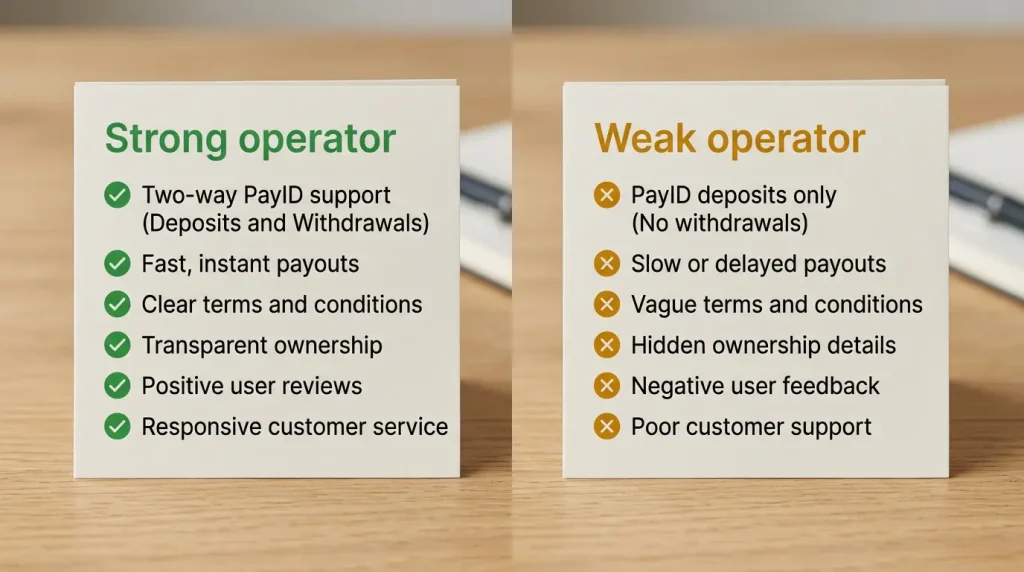
A weak operator inverts almost every one of those. It takes PayID for deposits but pays out by manual bank transfer or pushes you toward crypto. It holds balances in a foreign currency and converts on both ends. Its footer shows a licence logo that leads nowhere verifiable. Its “instant” withdrawal claim sits beside a terms page revealing a multi-day manual review with no weekend processing. Its bonus carries wagering so steep the offer is effectively a deposit lock. And its support, so eager before you deposit, develops a sudden communication problem the day you try to leave.
The reason I frame the comparison this way rather than as a branded table is simple: operators churn, domains change, and a ranked list is obsolete within months, while the profile of a trustworthy casino barely shifts from year to year. Learn the profile and you can apply it to whatever new name lands in front of you, which is worth far more than memorising five brands that may not exist by the time you read this.
Vetting an operator before you trust it with a dollar
Everything above collapses into a sequence you can run yourself, in order, before you deposit. Start by checking the operator against the regulator’s published block list, because if it is there, you are done. Confirm the licence at the source rather than from the footer logo, and confirm the jurisdiction has a real complaints process. Verify, by reading the cashier and asking support directly, that PayID works for withdrawals and not just deposits, and that your balance stays in Australian dollars throughout. Read the withdrawal limits and the account-freeze terms before, not after. Then, and only then, weigh the bonus.
I want to leave you with the mindset rather than a verdict, because the mindset is the durable part. The offshore reality of this market means the regulator is not going to recover your money if an operator decides not to pay, which puts the entire burden of selection on you. That sounds heavier than it is. Run the round-trip payout test with a small amount, verify the licence and the currency, read the terms that govern the bad day rather than the good one, and you will have done more genuine diligence than ninety percent of players ever do. The best PayID casino is not a name on someone else’s list. It is the one that survives your own twenty-minute audit, and now you know how to run it.
Frequently Asked Questions
How do I verify a PayID casino actually pays out?
Run a round-trip test before trusting it with real money. Deposit a small amount via PayID, play it through, then request a withdrawal back to the same PayID. A genuine two-way operator approves the cashout within its stated window and returns funds to your PayID. If the withdrawal is silently converted to a slow bank transfer or stalls past the advertised time, you have your answer, and it cost you only a small deposit to learn it.
Should I trust a casino's own best PayID casino badge?
No. A self-applied badge is marketing, not verification, and any operator can print one. The signals worth trusting are external and checkable: the operator's absence from the regulator's published block list, a licence you can confirm at the source rather than from a footer logo, balances held in Australian dollars, and PayID supported on withdrawal rather than deposit only. Judge the operator by what you can verify yourself, never by what it says about itself.
What licence should a PayID-friendly casino hold?
There is no Australian online casino licence for this product, so the licences you encounter are offshore by definition. That is not automatically disqualifying, but it changes what the licence buys you. An offshore licence from a jurisdiction with an active complaints process and visible enforcement carries weight; one from a jurisdiction that never intervenes is decoration. Always confirm the licence at the regulator's source, and treat any operator that is vague about its licensing entity as already failing the test.
Do the best PayID casinos support withdrawals or only deposits?
The best ones support PayID in both directions, and this is the single sharpest line between serious operators and the rest. Many casinos accept PayID for deposits because it gets your money in fast, then route withdrawals through a slower manual bank transfer. A strong operator states plainly in the cashier that PayID works for cashouts too, processes within a short and consistent approval window, and returns funds to the PayID you deposited from.
Payments
Instant PayID Withdrawals in Australia Explained
Understand how PayID identifies the bank account while Osko and casino approval influence when funds arrive. How PayID and Osko Shape Fast Casino Withdrawals For Australian casino customers, PayID is…
Best Novomatic Online Casinos Australia
Understand game maths, availability, state-based rules, mobile play and withdrawal conditions before…
Casinos That Accept MiFinity in Australia
A practical overview of MiFinity deposits, withdrawals, casino access and the rules…
How Anonymous PayID Really Is at a Casino
How anonymous PayID really is I get asked whether PayID lets you…
Casinos That Accept CashToCode in Australia
Understand the payment route, legal limits, account checks and practical issues linked…