
Playing Real-Money Pokies With PayID
 Available in US
Playing pokies with PayID
Pokies are the reason most Australians end up looking at PayID casinos in the first place, and I understand the appeal completely – they are quick, they are bright, and the deposit-to-spin gap can be a matter of seconds. PayID slots into that rhythm almost perfectly, which is both its strength and the thing I want you to be a little wary of.
Table of Contents
A pokie is just an online slot played for real money, with spinning reels, paylines, and the occasional jackpot, and “PayID pokies” simply means you funded that play through Australia’s instant-payment alias rather than a card. The pairing works because PayID lets you push a small amount from your banking app straight onto your balance, so you are spinning while the impulse is still warm. That immediacy is genuinely convenient, and I am not going to pretend otherwise.
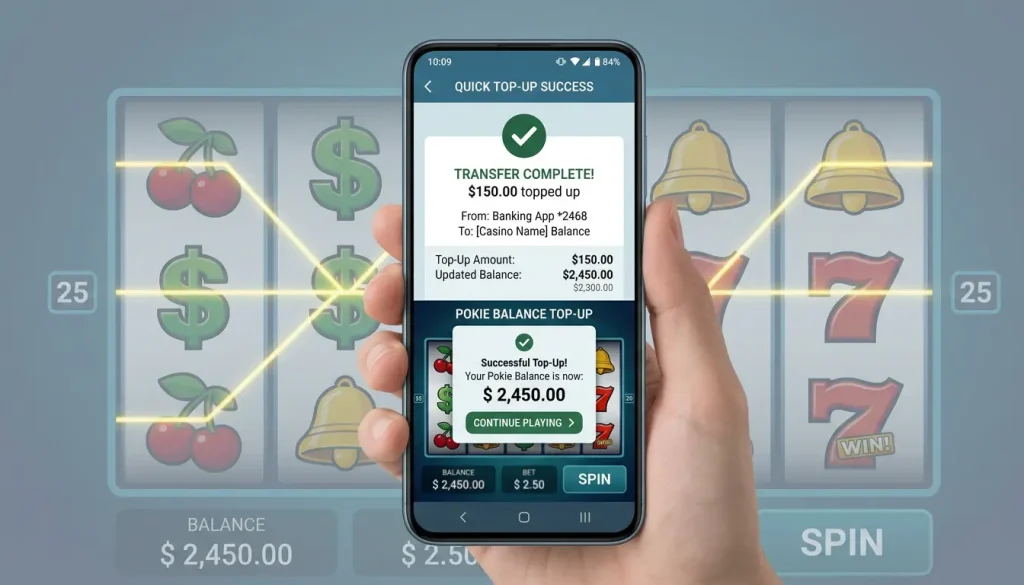
But I would be doing you a disservice if I led with the convenience and buried the maths. Every pokie ever built returns less than it takes in over time – the house edge is not a bug, it is the entire business model, and no payment method changes that by a single percentage point. So this piece does two things at once: it explains why PayID genuinely suits quick pokie sessions, and it keeps the return-to-player numbers honest so you go in with your eyes open. Convenience and clarity are not enemies, and you deserve both.
Why PayID suits quick pokies sessions
I think of pokie play as a sequence of small, fast decisions, and PayID matches that tempo better than almost anything else available to Australian players. The whole interaction – open the banking app, pay the alias, authorise with a fingerprint – takes less time than choosing which game to load.
The reason it feels so frictionless is that PayID rides instant rails that have become genuinely mainstream. Online wagering turnover in Australia surged 165.7% year on year to A$75.4 billion in the most recent figures, roughly 31% of all gambling turnover in the country, and a large share of that activity now happens on exactly the kind of mobile-first, real-time setup PayID was built for. You are not using an exotic payment method; you are using the same plumbing that handles ordinary money movement.

For pokie sessions specifically, three things matter and PayID delivers all three. The deposit is small and instant, so you can fund a single session deliberately rather than parking a large balance. There is no card sitting on file tempting an automatic top-up. And the transfer shows up immediately in your banking app, which means your real spend is visible the moment it happens. That last point is the one I value most – a pokie session can blur, but a banking statement does not, and PayID gives you a clean, timestamped record without any effort on your part. The same speed that makes it easy to start is the speed that makes it easy to track, and I treat that as a feature.
RTP, volatility and what the numbers mean
Ask ten pokie players what RTP means and you will get ten confident, slightly wrong answers. So let me make it plain: return to player, or RTP, is the percentage of all money wagered on a game that it pays back to players over an enormous number of spins. A pokie with 96% RTP returns, on average and across millions of spins, A$96 for every A$100 wagered – which means A$4 stays with the house.
The word doing the heavy lifting there is “average.” RTP is a long-run figure measured over vastly more spins than you will ever personally play, so it tells you nothing about your next hour. You can sit well above 96% on a lucky run or well below it on a cold one; the percentage only asserts itself across scales no single session reaches. Anyone who tells you a high-RTP game is “due” to pay does not understand the number.
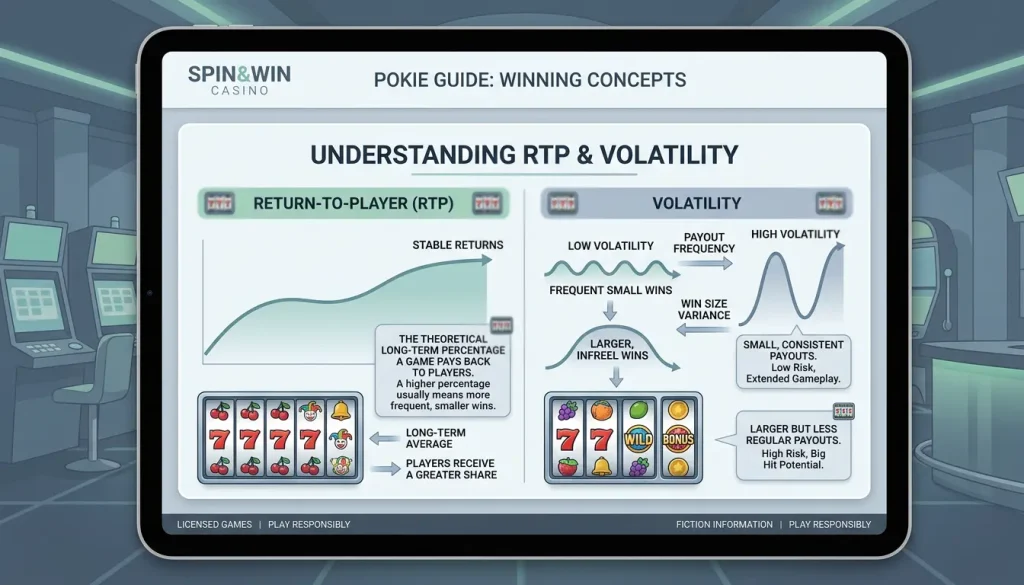
Volatility is the companion concept and arguably the more useful one for managing a small balance. A low-volatility pokie pays smaller amounts more often, which stretches a session; a high-volatility pokie pays rarely but larger, which can empty a small balance fast while you wait for a hit that may not come. Neither is better – they suit different goals – but if you have deposited a modest amount via PayID, low volatility simply gives you more spins for your money. And here is the part that matters for this article specifically: the payment method has zero effect on either number. RTP and volatility are properties of the game’s design, set by the studio that built it. Whether you funded with PayID, a card, or anything else, the reels behave identically. The convenience is in the deposit; the odds live entirely in the game.

Funding pokies sessions without overspending
The genuine risk with PayID and pokies is not the technology – it is how well the two fit together. A frictionless deposit method and a fast, repeating game are a combination that can quietly accelerate spend, and I have watched plenty of sensible people get caught by exactly that smoothness. The defence is structure, decided before you open the app.

My own rule, and the one I recommend, is to treat each PayID deposit as the entire budget for that session – full stop. Send one amount, play it, and if it is gone, the session is over. The moment you find yourself opening the banking app to push a second transfer “to chase it back,” the structure has already failed, and that is the precise behaviour the per-adult loss figures are built from. The convenience that helped you start is now working against you.
As Adrian Lovney of Australian Payments Plus put it, the design philosophy behind these payment tools is about giving people greater control and confidence when they move money – a powerful extra layer of protection built into the act of paying. I lean on that idea for pokies: the same banking app that funds your session is the one that shows you, in plain numbers, what the session actually cost. Mid-session top-ups are possible with PayID, but I would frame the ability to top up as the thing to resist rather than the thing to enjoy. Set the number, send it once, and let the reels do what reels do – within the limit you chose, not the one the game would happily extend for you. If you mostly play on a handset, the way the deposit flows through a casino app is worth understanding too, which I cover in the guide to PayID casinos on mobile.
Frequently Asked Questions
Does payment method affect pokies RTP?
No. Return to player is set by the game studio and is identical whether you deposit with PayID, a card, or any other method. The payment rail moves your money but has no contact with the game's internal odds.
Can I top up mid-session with PayID?
Technically yes, since a PayID transfer takes only seconds, but the ease of topping up is exactly the behaviour worth resisting. Treating each deposit as a fixed session budget is the more sustainable approach, and PayID's instant transfers make a top-up dangerously frictionless.
Are PayID pokies different from card pokies?
Only in how you funded them. The games, reels, RTP and volatility are completely unchanged by the deposit method - a PayID pokie and a card pokie are the same game played with a different funding route.
Guides
PayID vs POLi for Casino Payments
PayID and POLi: two Aussie bank methods For a long time, if an Australian wanted to fund an account straight from their bank without a card, POLi was the answer.…
Protecting Yourself From PayID Scams
Protecting yourself from PayID scams Here is the single most useful thing…
Using PayID on Mobile at a Casino
Using PayID on mobile PayID was born on the phone. It lives…
How Long Does a PayID Withdrawal Take?
A straight answer on PayID payout timing I will not bury the…
What BetStop Is and Who It Helps
What BetStop is and who it helps Sometimes the most useful tool…